Friday, December 16, 2022

After life?

Ay, but to die, and go we know not where,
To lie in cold obstruction and to rot,
This sensible warm motion to become
A kneaded clod; and the delighted spirit
To bathe in fiery floods, or to reside
In thrilling region of thick-ribbèd ice,
To be imprisoned in the viewless winds
And blown with restless violence round about
The pendent world; or to be worse than worst
Of those that lawless and incertain thought
Imagine howling—’tis too horrible.
The weariest and most loathèd worldly life
That age, ache, penury, and imprisonment
Can lay on nature is a paradise
To what we fear of death.

My neighbor Bob died recently. He was 89, but hale and hearty, a good, decent man, who lived across the street. He was looking forward to flying his private plane once more on his 90th birthday, some three months hence, but...oh well...

Everyone expected that his wife Ramona would go first, since she is in poor health, confined to a wheelchair, and was recently taken to a care facility since Bob could no longer manage her care all by himself. But then--Bob died instead--of an aneurism.

All this left me pondering, yet again, the great mystery of death; something that people over 70 like myself get used to, as our friends and neighbors our age or older fall away, one by one, and simply cease to exist. 

While cultures and religious traditions throughout the world have beliefs about the afterlife, a closer inquiry into these beliefs reveals that they have little, if anything, in common with one another. To take a simple example, both ancient Egyptians and modern Christians believed in some form of Divine judgment after we die, for our conduct while alive. But while Christians hold that we must confess our sins and beg for mercy before the throne of God, in order to go to heaven instead of being consigned to eternal torment in hell,  Egyptians believed, conversely, that they should recite examples of their virtuous conduct to the divine judge(s), in order to be rewarded with a good afterlife (for which they had to preserve their bodies intact as mummies, as well as their possessions to take along with them). And of course far eastern Dharmic religions--Hindu, Buddhist, Jain, Sikh, etc.--all generally believe in some form of reincarnation--that our present lifetime is one in an endless series, from past to future, generated by our karma--the net consequences of our actions while alive--and that this will go on until we pay off our accumulated karmic debts by virtuous conduct and meditation to achieve enlightenment, also called "Nirvana" (which literally means "extinction"). 

Who is right?  Anyone? Or are these all simply wish-fulfillment fantasies, while actually, there will be nothing at all after death, other than the decay, putrification, and ultimate recycling of our bodies, while our consciousness, that inner viewpoint behind our eyes, and restless chain of thoughts, feelings, and memories we call "ourselves" will simply vanish, in the same way as a computer screen goes dark when we pull the plug or take out the battery.

That is, as Hamlet says, the question: "To die, to sleep, no more..." or "To sleep--perchance to dream..."

I have no idea, of course, any more than anyone else. I incline, however, toward the view that this unique sense of self that I nurture from behind my eyes is more like a computer screen than anything else; it depends on a continuous source of solar energy, water, and carbon transformed into biomass, to power my physical, neural, and mental processes that model the environment around me, and all these processes take a unique form, based on my genotype, that never existed before and will never exist again. I will simply wink out, that is, when I draw my last breath and my brain, starved of oxygen and water, goes dark.  From a purely physiological perspective, I do not see where there is any other possibility.

But this is only a problem to the extent that we remain attached to this mental formation we call our "self." But what if that "self" is nothing more than a moire pattern, engendered by crosscurrents of air, earth (minerals), water, solar energy, and information, shaped by genetic predispositions inherited from our exponentially expanding array of ancestors? In which case, it will not just cease to exist--it never existed to begin with, as anything other than a convenient verbal construct, a way for a body, endowed with language, to maintain the membrane, both physical and social, necessary for it to function autonomously in an environment full of both things we crave (food, sex, toys, experiences, etc.) and things we fear (enemies, dangers, poisons, etc.)  So when our bodies meet their predestined end, we need not worry about losing ourselves--since we never existed to begin with as anything separate from the world we look out on through our eyes and other senses. We ARE Gaia...and when we die, we will simply melt back into Gaia, as the constituents of our bodies go on to become other beings...

Friday, December 2, 2022

Glomart, Gaia, and Garden Guilds

 Let's start with the basics, in the form of a catechism: 

Q: What is the biggest single problem in the world today?

A: The fundamental incompatibility between the production rules of Glomart and Gaia.

Q: What is "Glomart"?

A: The Global Market Economy, a self-organizing and self-propagating complex adaptive system based on the arithmetical logic (i.e. production rules) of money.

Q: What is the logic of money?

A: Basic arithmetic: (1) More is always better; (2) What's mine is not yours, and vice versa.

Q: What's wrong with that?

A: These two production rules engender an economy that has the following characteristics:

  • Nothing has value until it has a price.
  • Therefore, nature has no value at all until it is transformed into commodities.
  • Commodities must have discrete boundaries in order to be assigned a financial value.
  • The system depends on the endless growth of production and consumption of commodities.
  • As resources diminish, the rich get richer while the poor get poorer--inevitably--since possession of resources increases one's ability to raise prices for those who lack them.
Q: What is Gaia?
A: The living Earth, a self-organizing and self-propagating complex adaptive system based on the logic (i.e. production rules) of living organisms and their ecosystems interacting with their mineral, hydrological, and atmospheric systems, which provides the fresh water we drink, the food we eat, and the oxygenated air we breathe, and the climate (and shelter) we need to survive and propagate.

Q: What are those production rules?
A: These consist of the following:
  • Enough is  enough; all biological values are optimizing, rather than maximizing--too much or too little of any biological value is toxic to the system, whether that value is personal (e.g. body temperature or blood pressure) or collective (e.g. population density within an ecosystem). 
  • There are no discrete "commodities" in Gaia; the value of any biological entity depends on its interactions with its environment and with other biological organisms.
  • No matter what we may believe, we humans are a part of Gaia, and are every bit as dependent on these Gaian systems as every other organism on the planet.
Hence we have our predicament: Glomart--an inherently maximizing system that depends on endless growth of population, production, and consumption--is fundamentally incompatible with Gaia, an inherently optimizing system that is not growing any bigger, and in fact is already collapsing from overuse (via climate change, desertification, flooding, pollution, etc.)  And as the vast store of net energy (the very foundation of any material economy) available from fossil fuels is depleted, and its byproducts cause accelerated heating and chaotic fluctuations in our global climate, this basic contradiction between an "endless growth" economy and a finite biological support system is coming to a head. As we overshoot the limits of our energetic and biological support system, our global market economy is collapsing, first gradually, but then at an accelerating pace. There is no way out of this, at least collectively.

What about individually?  It's not certain, but here is one possibility.

What would happen if people with small bits of land at their disposal--front or back yards--started growing at least some of their own food. They would shortly find that there is much they don't know--much to learn--so (in addition to reading garden books or watching YouTube tutorials) they strike up a chat with their more experienced neighbors, as they are out in their gardens.

Then suppose a group of neighbors with interest in, or expertise in, growing their own food started forming neighborhood Garden Guilds, where they met once a month for potluck dinners, to share dishes, recipes, and ideas about gardening. On this basis, they started collaborating, so that people could expand their range of homegrown produce by trading it with their neighbors. As the garden guilds evolve, they could start holding reciprocal work parties as well, so that garden projects that exceed the strength or skills of one neighbor could be achieved by collaboration with others.

Multiple other benefits could arise from contiguous neighbors collaborating in this way. If, for example, a disaster struck--an earthquake, a drought, a wildfire, a flood, or a collapsing economy with hyperinflation, people would be surrounded by friends, rather than strangers, to whom they could reach out, whether to solicit or offer assistance. Ditto for external threats to the neighborhood, such as crime or violence.

Now imagine that city governments, Master Gardener chapters, churches, and civic organizations all jumped onboard, creating community-wide Garden Guild networks to promote and support the creation of Garden Guilds in adjoining neighborhoods, who all exchanged information and ideas with others. And imagine if the dominant theme of these Guilds was the study and practice of permaculture, based on the core ethics of Earth Care, People Care, and Fair Share.  The mission of the Garden Guild movement, therefore, is as follows:

Grow Gardens, Grow Community, Grow Awareness by Learning, Teaching, Healing, and Creating. 

This would be a gift economy, rather than a zero-sum money economy where the rich get steadily richer at everyone else's expense.  In short, it would resemble the indigenous, pre-Glomart economies of our ancestors, with the added benefits of scientific inquiry, technological know-how, and global awareness and responsibility.

While such a development will not prevent the inevitable collapse of Glomart, it could nevertheless sow the seeds of a Gaian culture to replace it eventually--a culture based on creating a symbiotic, rather than parasitic, relationship between humanity and our biological support system, our unique living planet Gaia. 


The Enigma of "Nonself"


When you've seen beyond yourself then you will find peace of mind is waiting there./And the time will come when you see we're all One and life goes on within you and without you..."

--George Harrison

Nonself--or No-Self--is one of the most perplexing and enigmatic themes in Buddhist teachings. Most people initially see the concept of "no self" as utterly absurd: "Of course there is a self. Look in the mirror!"

And in fact, most of us are completely obsessed with ourselves, most of the time: "How do I look?" "Why am I so sad today?" "I wish I were..." "I want that..." "I remember..." "Why am I so...?" and so forth. Such thoughts seem to swarm into our mindstream nonstop--except during those rare moments when we are "in the zone," completely absorbed with a present task: a musician playing a solo, a dancer doing a pirouette,  an eye surgeon operating on a patient,  a baseball player at bat. At such moments,  self-awareness can become a hindrance, or even a danger. But at most other times, our "selves" are often our constant obsession. How could there possibly be "no self"?

This obsessive sense of self that we carry around with us behind our eyes most likely has deep biological roots.  Every living organism, after all--from single-celled all the way up to the most complex multicellular being (such as us)--depends for its survival on maintaining a permeable membrane between itself and the world, to protect its own complex and delicate cellular or organic systems from threats to its survival, while letting in essential forms of sustenance (water, oxygen, carbon, solar energy converted into edible biomass), and also processing information about the world around them: edibles, water sources, potential mates, rivals, young, nesting materials or hiding places, and threats from predators. With the evolution of language in humans, this well-developed instinct for survival and propagation that is essential for all living organisms was reified in our linguistic head space as the concept of "me." So what is wrong with that? 

Nothing is "wrong" with it, per se--especially if it is just a survival instinct reified in our minds as a sense of "self." We are, after all, animals, who like all others, must eat safe food, breathe good air, drink potable water, take shelter, find mates, raise children,  and make decisions on our own behalf in order to survive. But the Buddha (and many other sages as well), through intense and prolonged meditation and introspection, discovered that this "self" we all cherish has no objective reality at all--it is simply a mental formation, like a moire pattern in an ongoing flux of matter, energy, and information within us and without us.


"But if this were true, we'd all be the same.  But I'm unique!"  We all think so. But how unique are we, really? On one hand, we are unique in the sense that each of us has a unique genotype, derived from both our parents' chromosomes, and thereafter our personalities are shaped, uniquely, by the interaction of our genetic predispositions and our personal experiences. But despite these differences, we are made of exactly the same basic stuff, both physically and emotionally, and this commonality enables us to empathize, both with those close to us, and with complete strangers, and with other animals as well. 

At a deeper level, of course, we all share the same basic genetic machinery as all other living organisms--the self-replicating interaction of DNA, RNA, and protein molecules. In this respect, we are "the same" as bacteria, protists, fungi, plants, and all other animals. Deeper still, we are all made out of ever-changing combinations of the same 100-odd basic elements (118 at last count, though approximately 20% of these are synthetic). And deepest of all (perhaps) we may all be nothing but vibrating strings of pure information...


So this is how I have come to understand this counterintuitive notion of "nonself." Not that "you and I don't exist," but rather, that you and I (and everyone and everything else) exist (temporarily) only because of ongoing interaction and interrelation with everyone and everything else in the universe. Or, as Dr. Martin Luther King, Jr. put it, "we are caught in an "inescapable network of mutuality" where "whatever affects one directly, affects all indirectly. ".  And just as every snowflake is different but they are all hexagonal because they are fractal expressions of the H2O molecule, so we are likewise all different, yet the same, as expressions one particular genotype that makes us human, differentiating us from other animals. Yet at the same time, we and all other animals, plants, fungi, protists, and bacteria are variations on a theme of the self-replicating interaction of DNA, RNA, and Protein--another moire pattern, made possible by the far larger moire patterns of matter/energy that have manifested, since the primordial event of the "big bang," as stars, galaxies, supernovas, planets, and black holes...

Friday, July 1, 2022

What is Meditation, Really?

In recent decades, our western consumer society, both here in North America and in Europe, has wholeheartedly embraced the East Asian core practices of meditation and mindfulness, but as with all such cultural borrowings, we have dramatically simplified and commercialized these practices, turning them into commodities for consumption in popular magazines, self-help books, TV programs, psychotherapy clinics, and even sessions at corporate conferences or stress reduction sessions for workers in the Pentagon! In the process, we have often stripped these practices of the richness of their original cultural contexts—and in the process, bastardized them.

In part, this is an entirely normal process; as it was with Christianity or Islam, Hindu and (primarily) Buddhist spiritual traditions have adapted themselves to the pre-existent sensibilities of other cultures as they have spread out from their cultures of origin, often losing much in the translation, but sometimes gaining in clarity and simplicity as they shed their original cultural trappings and constraints as well.  Very few American Buddhists, for example, practice with the rigorous discipline of Japanese Zen monks, the asceticism of Southeast Asian traditions, or the philosophical subtlety and ritual complexity of Indo-Tibetan traditions.

At their best, such simplifications (as with Thich Nhat Hanh’s stripped-down Buddhism or the Dalai Lama’s charismatic wisdom, simplicity, and humor) have inspired widespread adoption of very useful, effective methods for realizing the benefits of meditative practices, cultivating inner equanimity, and becoming more compassionate, and more actively and effectively involved in healing our social and ecological pathologies throughout the world.

But the widespread commercialization of “mindfulness” and “meditation” has also led, quite frequently, to narcissistic, self-serving attitudes like those found on the “Insight Timer” app (which opens with the query “How are you feeling today?” and features innumerable sappy recordings to play while cultivating self-absorption). This attitude has led to some ludicrous extremes, like one ad from an investment firm promoting “mindful money management” so that participants can get even richer, more quickly, with calm and deep concentration on their portfolios.

What is missing here?  One word: Ethics. Every authentic spiritual tradition on the planet, whether Indigenous; Western-Abrahamic (Judaism, Christianity, Islam—and their offshoots); or Eastern-Dharmic (Hindu, Buddhism, Taoism—and their offshoots) has had ethics at its core, rooted in the recognition that, as Martin Luther King, Jr. memorably put it, “We are caught in an inescapable network of mutuality, tied in a single garment of destiny. Whatever affects one directly, affects all indirectly.”  Or as the Buddhists put it, “This is because that is.” You will not find a single (authentic) religious sage, in any tradition on the planet, who would disagree with this basic insight, from which all ethical responsibility arises. This “inescapable network of mutuality” is, indeed, inescapable. It is our own living planet, and beyond that, the universe.

Hence another beautiful articulation of this core Dharmic insight: “Everything that lives is Holy” (William Blake).

So what does this have to do with mindfulness or meditation?  Simply this: Unless meditation is grounded in this fundamental awareness of the “inescapable network of mutuality,” it is just self-indulgence, no more “spiritual” than a prize fighter taking three deep breaths between rounds. It helps him—but nobody else.

So what exactly is meditation? There are, of course, many definitions, and to a considerable extent, those who practice meditation need to discover, for themselves, what it is—through their own practice, whether alone or under the guidance of a teacher or mentor.  So here is my own definition, which you can take or leave as you will:  Meditation is breathing, observing, and letting go. Again and again.

Let’s unpack these.

BREATHE: Whenever we talk of “spiritual” traditions or “spirituality,” the question arises (whether we visit this question or not), “What do we mean by ‘spirit?’”  For many, especially modern Christians, “spirit” refers to something nebulous and supernatural, the “Holy Ghost” that is somehow connected in the Trinity with God the Father and with Jesus the Son. Hence it is, for many, something they “believe in” just as they have been taught all their lives to believe in God and in Jesus as the Son of God.  But in fact, “spirit” is rooted in the Latin verb “spiro, spirare” which means “to breathe.” Not surprisingly, the same exact equivalence of “spirit” and “breath” can be found in other languages and religious cultures as well: “ruach” in Hebrew, “pneuma” in Greek, “prana” in Sanskrit, “chi” in Chinese, “ki” in Japanese—and so on. So we can safely say that spirit = breath.

But breath is not a thing; it is a process. From a biophysical perspective, the free oxygen we breathe is a transform of solar energy, released from plants as an energy-rich waste product of photosynthesis, and inhaled into our lungs to power our metabolism. And the Carbon Dioxide we exhale is essential plant food, enabling them, through photosynthesis, to manufacture simple sugars (C6-H12-O6) that serve as storage batteries for the energy they need to grow from seed to flower and fruit.  Thus, our breathing in and out is deeply connected with the breathing out and in of plants, another instance of that “inescapable network of mutuality” that entwines us all…

So breath is spirit because it connects us, literally, with everyone and everything else. If we breathe in that spirit (if you will pardon the word play), we are meditating. If not, we are simply doing what someone else told us to do, without knowing why.

OBSERVE: One immediate benefit of simply following your breath with your awareness—the core instruction of meditation—is that you stop thinking about anything else, if only for that moment. And this enables you to observe—to look deeply, first at your own breath, in and out; then at the body which is doing the breathing; then at whatever physical and emotional sensations are playing in and around your body and mind; then (with more practice) at your own mental processes, and finally, at your inner narrative—the things you are thinking about, dreaming about, fantasizing about, or fretting about. Simply stepping back, as it were, and observing these things from a place of calm induced by slow and steady breathing means that you are no longer obsessed with them, whether it is a pain in your left leg, a disturbing memory, a flare-up of anger with your spouse or children, or a craving for chocolate. Observing them detaches you from them; you learn to simply acknowledge their presence, with compassion for yourself and others—and with practice, even for those who may have triggered the anger, desire, or obsessive thoughts and feelings.

LET GO: Just as attentive breathing is a prerequisite to observing yourself and others with insight and compassion, observing, in turn, is a prerequisite to letting go. You know you have let go, as Thich Nhat Hanh points out, when you can gently smile at your own passing thoughts and obsessions.  Putting it simply, we breathe in order to observe, observe in order to let go, and let go in order to breathe.

It takes a lot of regular practice—you will not “get it” right away. All of us—even experienced meditators—get distracted, all the time. But rather than beating yourself up for getting distracted yet again, the key—once again—is compassion, first toward yourself and then toward others—especially those who may have triggered you with obsessive feelings of anger, rage, or even the converse, like lust.

And then—once you have forgiven yourself for getting distracted (and other people, memories, or things for having distracted you)—simply go back to your breath and start again.

Here is a simple mantra you can use as “training wheels” for meditation: BREATHING, OBSERVING, LETTING GO, ABIDING.   I did not bother expanding on “Abiding” because it is not a practice in itself—it is the goal of practice.  We BREATHE with gratitude and benevolence; we OBSERVE with insight and compassion; we LET GO with joy and relief, and at that moment, we are ABIDING in equanimity and peace. Repeat as often as necessary.

Saturday, April 30, 2022

Life without hope


"We all sit here stranded, though we're all doing our best to deny it." --Bob Dylan

This is a difficult post to write. Despite everything, I have always been a congenital optimist, even though I have prided myself on my ability to look unblinkingly into the vortex and still find a reason to hope. My habitual metaphor has been my ardent hope for some viral, self-replicating "butterfly effect" that would trigger the "spontaneous remission of the Cancer of the Earth." But there comes a time...and for me, that time has come. Let me begin with a quote from a writer I follow on Medium named Richard Crim, who is very proficient in climate science:

The last time CO2 levels like this were seen on Earth, was three million years ago, according to the most detailed reconstruction of the Earth’s climate by researchers at the Potsdam Institute for Climate Impact Research (PIK) and published in Science Advances.

At that time, there were no ice sheets covering either Greenland or West Antarctica, and much of the East Antarctic ice sheet was gone. Beech forests were growing in Antarctica and temperatures were up to 7 degrees Fahrenheit (4.℃) warmer globally, at least double that at the poles, with sea levels some 20 meters (65 feet) higher than today.

This quote says it all. By raising CO2 levels to their current level, closing in on 450 ppm, we have initiated a host of irreversible, interlocking feedback loops that will dramatically accelerate the heating of the Earth, regardless of what we do to stop carbon emissions. But unlike the last time (3 million years ago), this heating will not be gradual, and hence will not enable the biota to adapt over hundreds of thousands--or millions--of years. Crim has coined the apt term "bomb time" to describe our current predicament.

Think of it this way: human time scales, compared to geological time scales, are infinitesimal--like the blink of an eye. Yet in the last 70 years--my lifetime--the CO2 level in our atmosphere has risen from roughly 300 ppm--slightly higher than the average high of 280 ppm over the previous 800,000 years (as measured in the bubbles of antarctic ice cores)--to the current, utterly unprecedented level of 420 ppm and rising steadily. When you graph my lifetime onto a geological time scale, it is the merest blip.  Yet within this blip of time, the atmospheric CO2 level has shot up, almost vertically, as seen on this graph:


In short, the fossil fuel age of the last 150-200 years looks, on a geological time scale, like a brief spike in energy release that could be compared to a volcano or a meteor impact--or a bomb. This means that this explosion of energy released into the atmosphere from the global proliferation of fossil fuels will play out inexorably in the next few decades, as the convergent feedback effects of loss of albedo from melting ice at both poles and all mountain ranges, methane release from melting permafrost, carbon release from wildfires and logging, ocean heating and acidification (and carbon release the calcium carbonate that builds dying coral reefs and shellfish), sea level rise, loss of (carbon-sequestering) vegetation due to prolonged drought, violent storms and floods, wildfires and so on. All of these destructive trends are strongly predicted to accelerate in the coming years, until the global climate reaches a new homeostasis, a new, higher set point, that is well beyond the tolerance of most of today's biota--at least large multicellular organisms like ourselves, or the food we eat. (Bacteria and fungi will do fine, no doubt, since they reproduce and evolve far faster than we do, and can already withstand temperature extremes far beyond our own tolerance.)

When you put all these (fully validated) climate data together, the conclusion is inescapable: we are fucked, and any effort to reduce climate emissions, convert to electicity, stop eating meat, or launch vastly expensive (and energy-intensive) geoengineering schemes--will be like arranging deck chairs on the Titanic. Or to cite another, perhaps more apt cliche, our goose is cooked, regardless of what we do.

So how do we live without hope? That is the question for this generation--which may well be the very last generation of humans--ever. I don't pretend to have a satisfactory answer to this conundrum, but these thoughts may help somewhat.

First, remember that the present is all there is. The future is just a mental formation, enabled by the unique gift of human language, which enables us to imagine such a thing. It does not actually exist, however, except in our minds. 

I learned this lesson from a hummingbird I saw hovering and feeding on a hanging fuchsia on the shady side of our house, during the utterly unprecedented heat wave of last summer, when the temperature here in the (normally cool and pleasant) Willamette Valley rose to an ungodly 114 degrees.  The hummingbird, like me, was suffering from the heat--and like me, he is doomed.  But he needed to eat, to sip the lifegiving nectar of that fuchsia, and the sight of him sipping from the flowers despite the torrid heat gave me a transport of grace, a moment of pure joy, that has stayed in my memory ever since. Having no concept of "the future," the hummingbird was enthusiastically embracing the present moment--the delicious, life-sustaining nectar--despite the appalling temperature. So should we all embrace such moments of grace as they arise: the laughter of children, the eyes of our beloved, a delightful symphony or string quartet,  the rising sun over a misty lake... they are truly all that matter, impermanent though they may be.

So here are a few humble suggestions for coping with a world without hope, with no future at all.

  1. Breathe, Observe, and Let Go. Cultivate a spiritual practice every day. It does not matter which brand you choose, or what you "believe;" they all have useful  practices for facing and enduring the traumas and vicissitudes of life. The main benefit of all such practices is that they help you accept that that is, to let go of wishing things were other than they are (such longing is the source of all human vices and all human suffering). If you are a "believer," try "Thy Will be done" as a good mantra; if you are not, try the old Walter Cronkite sign-off, "That's the way it is." Whatever works best for you. 
  2. Be well, Do Good Work, Keep in Touch. Take care of everyone and everything, and abandon no one and nothing.  Starting with yourself, take good care of your body, feelings, and mental state; then turn to your livelihood and daily tasks, and attend to them mindfully; finally (and most importantly) be there for those closest to you--spouse, family, friends--expanding your circle of care to include everyone you encounter, and ultimately, all living beings, including even your enemies. My own favorite mantra for this is a line from William Blake: "Everything that lives is holy"--however impermanent.
  3. Learn, Teach, Heal, and Create. No matter what happens as the momentum builds in the ongoing and accelerating collapse of our civilization and biological support system, organize your life around these four standing goals: to cultivate resilience through the constant learning of new knowledge and skills; to teach what you know to others; to heal, as best you can, your own and others' physical and emotional distress, and to take care of the portions of our living planet entrusted to us--our own gardens, farms, and communities; and finally, to use your creative gifts in whatever ways nourish your own life and that of others. Hence the slogan I have put on my own self-designed bumper-sticker that sums up all of the above, a succinct recipe for cultivating resilience in a time of growing chaos and catastrophe:  Grow Gardens, Grow Community, Grow Awareness.

Wednesday, April 13, 2022

Tetrads


The above two symbols, the tetrahedron and the solar cross, are both sacred images based on the number four--the Tetrad--associated with the Earth, or Gaia, and symbolizing manifest stability and totality; hence we have the four seasons; the four classical elements (Earth, Air, Fire, Water) which are also the four basic requirements for life; the four limbs of vertebrates; the four corners of most buildings; and the four dimensions of space-time (length,width, depth, and time).

 In Buddhism, the number four also has many foundational uses, including the Four Noble Truths, the Four Brahmaviharas ("Abodes of God" or adaptive mental attitudes), the fourfold mantra (Om Mani Padme Hum) representing the totality of the Dharma. For today's Dharma Talk, I would like to map these Buddhist tetrads onto one another, and onto my favorite mantra, or core injunctions of meditation (Breathe, Observe, Let Go, Abide) in order to investigate the insights that arise from this superposition. The correlations are as follows:

OM--Breathe--First Noble Truth (Suffering)--Benevolence

MANI--Observe--Second Noble Truth (The Causes of Suffering)--Compassion

PADME--Let Go--the Third Noble Truth (Realization or liberation)--Sympathetic Joy

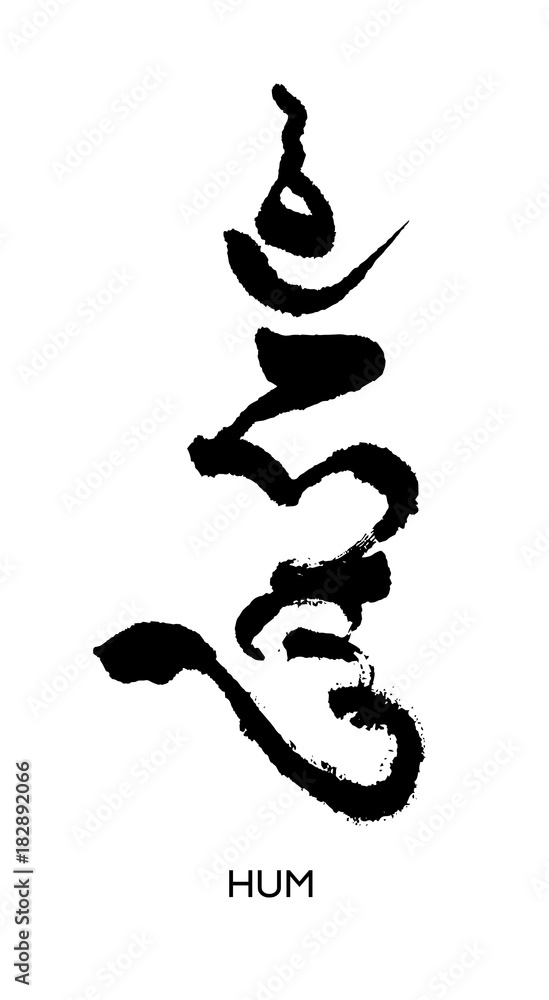
HUM--Abide--the Fourth Noble Truth (The Path of awakening)--Equanimity.


OM, the seed syllable of the Cosmos.


Om (sometimes rendered "AUM") is the sacred seed syllable in all Dharmic religions--Hindu, Buddhist, and all others.  It is often described as both the name and the voice of God, or the Sacred itself, and reciting it with full attention is said to achieve ineffable communion with the Divine--with all that is. Therefore, it can aptly be correlated with the first injunction: BREATHE, since "breath" and "spirit" share the same root meaning (Latin spiritu from spiro, spirare--to breathe) and are synonyms in most other languages (e.g. ruach (Hebrew), prana (Sanskrit), and Qi (Chinese) or Ki (Japanese). 

Hence, both OM and BREATHE correlate with the first of the Brahmaviharas, Maitri (Pali Metta), whose meanings combine gratitude and benevolence--the default attitude we should take toward everyone and every other living being when we encounter them, and more deeply,  gratitude for the sacred miracle of life itself, as we take each breath.


MANI, the Sanskrit word for the Jewel of Karuna or compassion. 


Whereas Maitri is the default attitude we should cultivate toward everyone, Karuna or compassion is the attitude we assume toward all who suffer. It is not, simply "pity," however. It refers to active identification with all who suffer (including ourselves), coupled with an authentic determination to help alleviate their suffering in any ways we can. Hence it is correlated with the second injunction, OBSERVE, to look deeply into the suffering of ourselves and all other beings.


Padme, the Lotus of full awakening.


Padma (or Padme) refers to the Lotus--a sacred symbol throughout the Far East--as a symbol of full awakening or enlightenment--rising pristine above the muck, like a magnificent flower in a wetland. Hence it is correlated with the third injunction--LET GO, or to free oneself from all afflictive attachments, all "wishing things were other than they are."


HUM, the "Peace that passeth all understanding."


The Fourth seed syllable wraps up all the others, and hence symbolizes the fourth Brahmavihara: Equanimity. It also can be correlated with the Fourth Noble Truth--the Path of Awakening, which the Buddha outlined, in his inaugural Sermon at Benares, as the Eightfold Path: Right Understanding, Right Aspiration, Right Speech, Right Action, Right Livelihood, Right Effort, Right Mindfulness, and Right Concentration.  And it can be invoked nicely by the injunction "Abide."

There are many meditative practices that can be derived from this superposition of Buddhist tetrads. For example, one could start by inwardly reciting, on four consecutive breaths, the following mantras or injunctions in any sequence you wish:

1. Breathe with gratitude, Observe with compassion, Let Go with selfless joy, Abide in equanimity;

2. Suffering, the Roots of Suffering, the Release from Suffering, the Path of Cultivation;

3. Benevolence, Compassion, Joy, Equanimity

4. Om Mani Padme Hum

Improvise as you wish, but also remember that Mantras are simply training wheels, which you can let go of when you no longer need them...

Monday, March 7, 2022

This could be it.

“He who is the author of a war lets loose the whole contagion of hell and opens a vein that bleeds a nation to death.”--Thomas Paine

All changed, changed utterly:   
A terrible beauty is born. --W.B. Yeats

As everyone now knows, Putin has invaded Ukraine, and it is not going well for him, despite his overwhelming advantage in firepower, as he steadily escalates the mass murder and mayhem he is inflicting on the Ukranian people. The entire world has condemned and isolated him, cutting off Russia from commerce, the performing arts, and sports, and sequestering their finances... As a result, the Russian economy is now in a nosedive, his currency essentially worthless, and his hapless citizens, increasingly destitute, desperate, and disillusioned. Meanwhile the Ukrainian people, despite his relentless and increasing bombardment, are united against him, inspired by their heroic leader Zelenskyy, and are willing to fight to the death no matter how much horror and suffering he inflicts on them.

What worries me most is that Putin has burned his bridges; like Macbeth, he is "...in blood / Stepped in so far, that, should I wade no more, / Returning were as tedious as go o'er (III. 4.136–8) 

He cannot possibly "win" in Ukraine without destroying the entire nation and terrorizing its population, and making yet more enemies around the world (a Pyrrhic victory indeed!). And he'll have his hands full trying to subjugate a population of 40 million who loathe and despise him (as they discovered to their cost in Afghanistan).   But on the other hand, he cannot withdraw, without losing face, and hence--in Russia especially--losing power and most likely, his life as well.  Furthermore, narcissistic thugs like Putin (and Trump) are incapable of admitting failure, for that is tantamount to the death of their own bloated ego, which they worship as a deity, and which he equates with the tribal deity he shares with his people: "Mother Russia."

His only other option is nuclear war--with which he has already darkly threatened the West, and which he knows (with whatever rational faculties remain in his fevered brain) is tantamount to suicide, not only for himself, but for all the rest of us. And herein lies the true peril of this moment. This could be it--the end of human civilization, the end of most if not all of us, the end of most larger living beings, and the end of Gaia as a habitat for human life. Will it come to this?

Who knows? Anything can happen. But the odds of this unimaginably horrific outcome are becoming more likely by the day. My one remaining hope is that a cabal of his own oligarchic cronies will conceive of a multipronged strategy to dispatch him, before it is too late. As a Buddhist, I am not supposed to wish ill, and especially to wish death, on anyone--but then one of the Jataka tales of the Buddha's earlier incarnations featured the protagonist willingly taking on a karmic debt by murdering a ship captain who was plotting to drown all 200 of his passengers--and this might be an analogous case.

The real challenge here, however, is that up to now, Putin has gained wide popularity in Russia by being a strong leader who restored Russia's economy after the Soviet collapse and thereby restored their global standing, and who weakened and humiliated Russia's historical adversaries in Europe and the US in particular, by scheming to appeal to British nationalism and undercut the EU by organizing the Brexit campaign behind the scenes, and to elect his own "useful idiot" Donald Trump to the presidency, and dividing the nation. (These were all actions for subverting his enemies that would impress Machiavelli!) However, with this bloody and brutal invasion of Ukraine, Putin has stepped over the line (as Hitler did), making the fatal transition from steely, competent authoritarian to paranoid, ruthless, and dangerous thug.

But if anyone dispatches Putin, it must be Russians themselves--for if we in the West were to attempt such a thing, it would simply unite the Russians against us, make Putin a martyr to Russian nationalism, and most likely trigger a nuclear war that will end everything.  Nontheless, as a highly intelligent, subtle, and crafty people, some of the high-placed Russian oligarchs might already have considered this option. We can only hope. (I hold out some hope for a Brutus-like figure--a high-placed Russian oligarch who is Putin's trusted confidante, to realize the danger he poses to all civilization and life on Earth, and plot a quick way to dispatch him...) 

Otherwise the best we can do is (1) practice Tonglen for the Ukrainian people (breathe in their vast suffering and fears; breathe out solidarity, determination, and hope); (2) even try Tonglen for Putin himself (breathing in the inner fears, resentments, and insecurities that engender his desperate and neurotic lust for power and restoration of empire, and breathing out the wisdom he has abandoned--awakening his dormant Buddha-nature from underneath all the layers of fatuous egocentricity. (3) practice the Gesthemane Prayer (Matt: 26: 36-56): 

O my Father, if it be possible, let this cup pass from me: nevertheless not as I will, but as thou wilt.

These are the best antidotes I know for paralytic anxiety about the world.

And if, indeed, all is lost--if our only remaining options are a quick and ugly death by nuclear holocaust, or a slow and excruciating death by global heating, starvation, endemic warfare, and ecocide--

"O my Father, if this cup may not pass away from me, except I drink it, thy will be done."

And meanwhile, let us all take care of everyone and every being, and abandon no one and no other living thing. Let us therefore, for now...

Breathe, observe, let go;

Be well, do good work, keep in touch;

Learn Gaia, Teach Gaia, Heal Gaia, and Create Gaia;

and then...

Grow gardens, Grow community, and Grow awareness.

...till death do us part.